
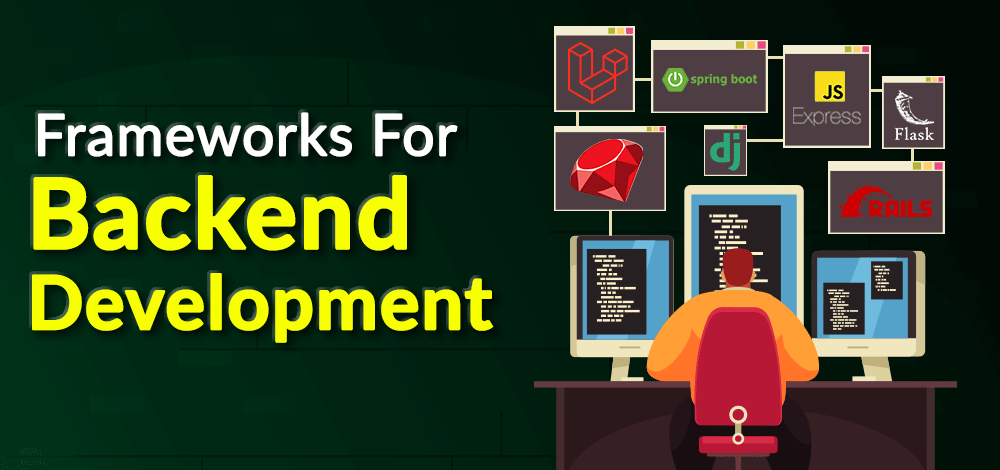
Back end development relies heavily on programming languages and frameworks that power server side logic, data processing, and application security. Choosing the right back end technology is a critical decision because it impacts performance, scalability, development speed, and long term maintenance. Over the years, several programming languages and frameworks have emerged as industry standards due to their reliability and strong ecosystems.
This blog explores some of the most popular back end programming languages and frameworks and explains where each one fits best.
Table of Contents
JavaScript with Node.js
JavaScript is no longer limited to front end development. With the introduction of Node.js, JavaScript can now run on the server side, enabling developers to build full stack applications using a single language.
Node.js is built on Google’s V8 engine and is designed for high performance and non blocking I O operations. This makes it ideal for real time applications such as chat systems and streaming services.
According to
Node.js official documentation, Node.js is widely used for scalable network applications due to its event driven architecture.
Popular frameworks built on Node.js include Express.js and NestJS, which simplify routing, middleware management, and API development.
Python with Django and Flask
Python is known for its readability and simplicity, making it a favorite among developers. In back end development, Python is commonly used with frameworks such as Django and Flask.
Django is a high level framework that follows the batteries included philosophy. It provides built in features for authentication, ORM, and security, making it suitable for large scale applications.
Django’s official documentation highlights its focus on rapid development and clean design.
Flask, on the other hand, is a lightweight that gives developers more flexibility and control. It is often used for small to medium sized applications and RESTful APIs.
Java with Spring Boot
Java has been a dominant back end language for decades, especially in enterprise environments. Spring Boot is a popular framework that simplifies Java application development by reducing configuration and setup complexity.
Spring Boot supports microservices architecture, REST APIs, and strong security mechanisms. It is widely used in banking, healthcare, and large enterprise systems.
Spring Boot’s official documentation explains how it enables production ready applications with minimal configuration.
PHP with Laravel
PHP remains one of the most widely used back end languages, especially for web development. Laravel is a modern PHP framework that provides an elegant syntax and a rich set of built in tools.
Laravel simplifies tasks such as routing, authentication, database management, and caching. It is commonly used for building web applications and APIs quickly.
Laravel’s official documentation emphasizes developer productivity and maintainability.
C# with .NET
C# is a powerful back end language developed by Microsoft and commonly used with the .NET framework. It is particularly popular in enterprise environments and Windows based systems.
.NET supports building web APIs, cloud services, and enterprise applications. It integrates well with Microsoft Azure and other Microsoft tools.
Microsoft’s .NET documentation provides detailed guidance on building secure and scalable back end applications.
Comparing Languages and Frameworks
Each back end technology has its strengths. Node.js excels in real time and event driven applications. Python frameworks offer simplicity and rapid development. Java and Spring Boot are ideal for large scale, mission critical systems. PHP with Laravel is well suited for fast web development, while .NET is a strong choice for enterprise and cloud based solutions.
The right choice depends on project requirements, team expertise, scalability needs, and ecosystem support.
Importance of Frameworks in Back End Development
Frameworks provide structure, best practices, and reusable components that speed up development and reduce errors. They handle common tasks such as routing, security, and database interactions, allowing developers to focus on business logic.
Using a well supported framework also improves maintainability and security over time.
Conclusion
Back end programming languages and frameworks form the foundation of server side development. From JavaScript with Node.js to Python, Java, PHP, and C#, each technology offers unique benefits for different use cases.
Understanding the strengths of popular back end languages and frameworks helps developers and organizations choose the most effective tools. As back end development continues to evolve, selecting the right technology stack remains a key factor in building robust, scalable, and secure applications.
Also Check Back End Development – Comprehensive Guide – 2026
1 thought on “Popular Back End Frameworks and Languages Explained 2026”